.png)


Weather Data in Haiti
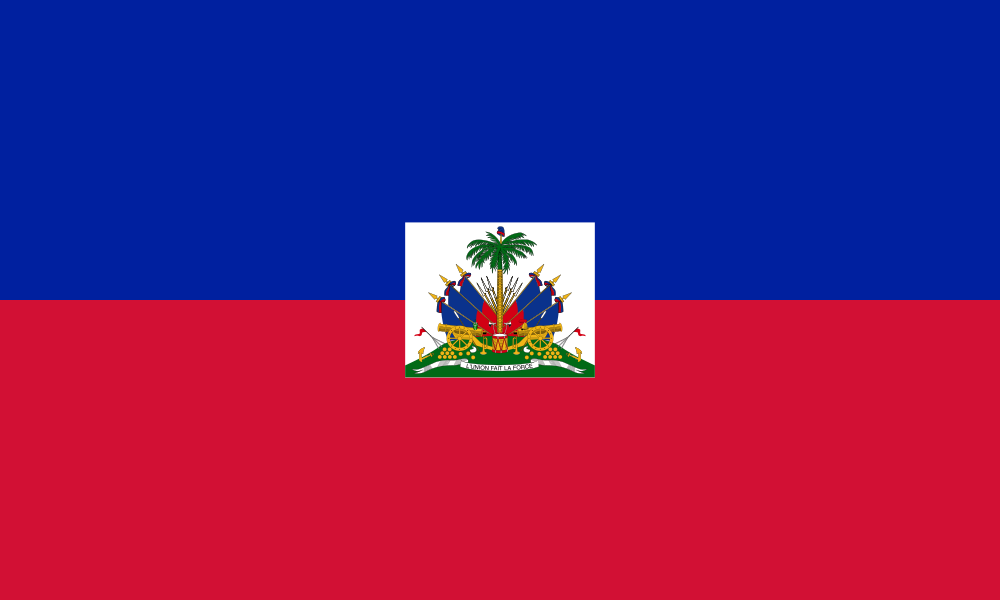
Weather Data in Haiti

Techsalerator's Weather Data for Haiti
Techsalerator's Weather Data for Haiti provides a comprehensive view of the country's climate landscape. Haiti has a tropical climate significantly influenced by its mountainous terrain, which creates stark rainfall contrasts between windward and leeward slopes. The north and east are wetter, while the southern peninsula and west can be quite dry. Haiti is one of the most climate-vulnerable nations in the world, repeatedly devastated by hurricanes, tropical storms, and associated floods and landslides. Deforestation has severely worsened flood risk. This dataset enables businesses, researchers, and governments to understand climate dynamics, weather patterns, and environmental conditions across Haiti's diverse geography.
Top 5 Most Utilized Data Fields
- Hurricane Track & Landfall Records: Devastating Atlantic storm data including Matthew 2016 and historic impact events.
- Orographic Rainfall Contrast Data: Dramatic windward versus leeward rainfall gradients across Haiti's mountain ranges.
- Flash Flood & Landslide Risk Data: High-intensity rainfall combined with severe deforestation creating catastrophic flood events.
- Drought & Southern Peninsula Data: Dry climate data for Haiti's most food-insecure regions in the southwest.
- Temperature & Wet Season Records: Seasonal wet season temperature and humidity data for agriculture and health.
Top 5 Use Cases for Weather Data in Haiti
- Hurricane Disaster Preparedness: Provide storm track and rainfall intensity data for Haiti's chronically underprepared civil defense.
- Flood & Landslide Disaster Risk Reduction: Map extreme rainfall and deforestation overlap to identify highest-risk communities.
- Agricultural Drought Monitoring: Support mango, coffee, and food crop farming with wet season onset data.
- Humanitarian Logistics Weather Planning: Use weather forecasts to optimize post-disaster aid delivery routes.
- Urban Flood Risk in Port-au-Prince: Monitor extreme rainfall risk for Haiti's capital still recovering from the 2010 earthquake.
Top 5 Locations with Notable Weather Data Trends in Haiti
- Port-au-Prince: Capital in flood-prone bay; extreme vulnerability to hurricane surge and flash floods.
- Cap-Haitien: Northern city; wettest major city in Haiti with Atlantic moisture and mountain orography.
- Les Cayes: Southern port; near the track of Hurricane Matthew 2016 catastrophic landfall.
- Jacmel: Southern coastal city; warm Caribbean climate with moderate but unreliable rainfall.
- Gonaives: Central plain city; devastated by Tropical Storm Jeanne 2004; highly flood-vulnerable.
Accessing Techsalerator's Weather Data
To obtain Techsalerator's Weather Data for Haiti, contact [email protected] with your specific requirements. A customized quote will be provided based on the data fields, volume, temporal range, and update frequency needed. Datasets are typically available within 24 hours, with ongoing access options for continuous data needs.
Included Data Fields
- Historical & Real-Time Temperature Data
- Precipitation & Rainfall Records
- Wind Speed & Direction
- Humidity & Dew Point Data
- Solar Radiation & UV Index
- Extreme Weather Event Records
- Forecast & Climatological Normals
Techsalerator's Weather dataset is an essential resource for agriculture, energy, insurance, logistics, construction, and research organizations seeking to understand and plan effectively around Haiti's climate conditions.
Weather Data for Haiti
Q: How much does the Weather Data Dataset for Haiti cost?
The cost of the Weather Data Dataset for Haiti depends on factors such as the number of data fields, geographic coverage, temporal depth, update frequency, and total record volume. For an accurate pricing estimate, contact a Techsalerator data specialist who can provide a tailored quote based on your specific needs.
Q: How complete is the coverage of Weather Data in Haiti?
Techsalerator's Weather Data for Haiti provides comprehensive coverage across all major climate zones, geographic regions, and weather variables. The dataset draws from a wide network of ground stations, satellite observations, and reanalysis products to deliver a complete picture of weather conditions throughout the country.
Q: How does Techsalerator collect this data?
Techsalerator gathers Weather Data from diverse, reliable sources including national meteorological services, WMO-affiliated weather station networks, satellite remote sensing platforms, ocean buoy networks, and climate reanalysis datasets. All data is quality-controlled and validated to provide accurate and consistent weather insights for Haiti.
Q: Can I select specific variables, time periods, or geographic regions within Haiti using Techsalerator's Weather Data?
Yes, Techsalerator allows you to filter and customize datasets by weather variable (e.g., temperature, precipitation, wind, humidity), geographic region, specific weather stations, or time period. Work with a Techsalerator representative to configure the dataset to match your exact analytical objectives.
Q: How do I pay for this dataset?
Techsalerator supports multiple secure payment methods, including credit card, direct bank transfer, ACH (Automated Clearing House), and wire transfer. Clients can choose the method that works best for them.
Q: How do I receive the data?
The Weather Data is delivered through secure channels such as FTP, SFTP, S3 bucket, or email. Data formats include JSON, CSV, TXT, NetCDF, or XLS, allowing easy integration into your analytics workflows, GIS platforms, and climate modeling systems.